NEAR Foundation’s new CEO on defining web3 and her return to the blockchain space

Quick Take
- NEAR Foundation’s new CEO explains why she left banking for the blockchain world.
- From day one, her mission will be to define the NEAR protocol as the go-to place to build what’s increasingly being referred to as ‘Web3’.
We'd love your feedback.
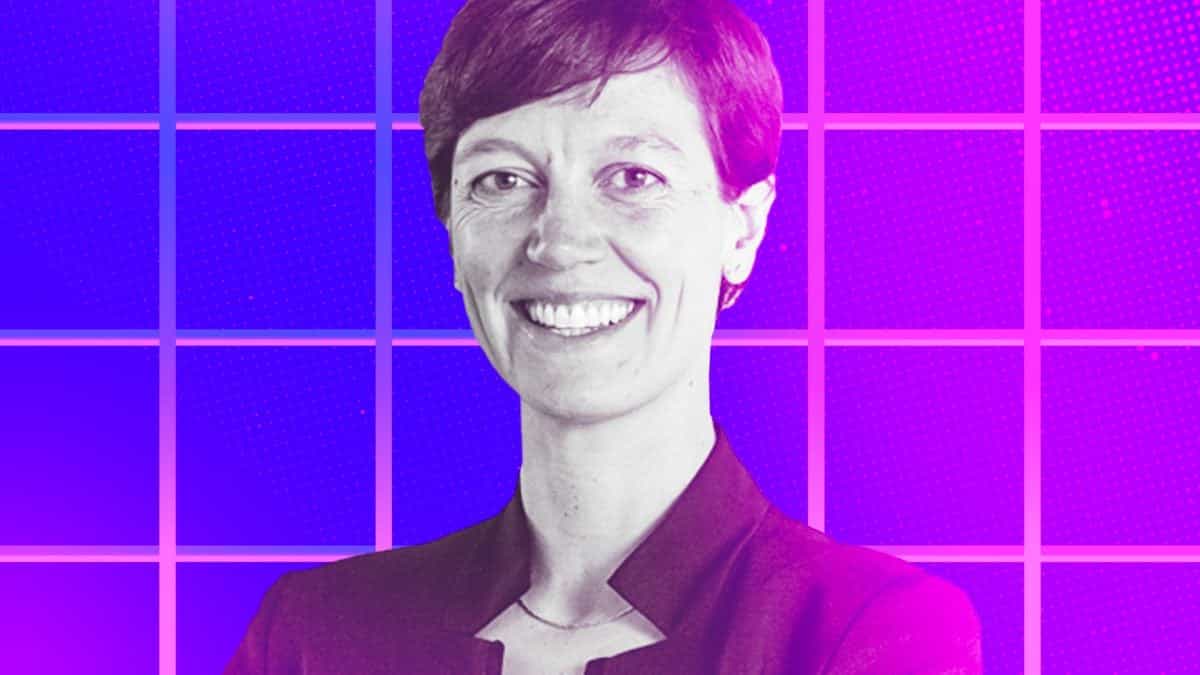
In the midst of a widespread debate about web3’s definition, its mission, and its ownership, Marieke Flament’s move, from leading a fintech bank in London, back to the blockchain comes at an opportune moment.
Set to take on the role of NEAR Foundation’s CEO starting January 1, the fintech stalwart is on a PR drive to make the platform the go-to place for the next iteration of the web.
“How can we be known as a place where you can build an open web or web3?” she asks. “We want to create a world where we’re automatically associated with it.”
Zug-based NEAR launched in 2020 shortly after it closed a $21 million token sale, drawing support from the likes of Andreessen Horowitz (a16z) and Pantera Capital. The non-profit platform, which oversees the development and governance of a proof-of-stake blockchain, recently upped the stakes among its peers with an $800 million grant fund for projects.
When NEAR announced the fund, it stipulated it would look to spend $250 million of that amount through ecosystem grants over four years, create a regional fund of $100 million and allocate $100 million specifically for startups.
The remaining $350 million is channeled through Proximity Labs and will be focused primarily on DeFi with spending governed by a “DeFi DAO,” through which protocols will be able to apply for liquidity mining programs. Proximity is a group of NEAR contributors that was spun out of its parent company as an independent entity.
As projects develop and the money is spent, French-born Flament sees NEAR’s role as having a similar remit to that of a venture capitalist.
“When you start creating a company, VCs often have people who help you for HR and people who help you for marketing and product,” she says. “That’s already something we’re looking at doing.”
She went on to say:
“It’s asking how we can serve the ecosystem and make sure it thrives. The technology is just one part. How do we create the things we believe open web could be or should be?”
Ownership and inclusivity
One thing cynics of web3 have questioned in recent weeks and months is whether it can be truly decentralized with the same old institutional names backing it.
Flament says the volume of capital being allocated to its development is a testament to the fact that things built on the blockchain could have as wide a reach as the current internet. The potential for reach and innovation is the draw, rather than ownership she says.
“There’s definitely an influx, and a realization that, in the same way the internet touched every layer, we’re starting to get there, being able to say that actually what blockchain will do is touch every vertical of everything that’s happening,” she says of the funding rush.
As interest ramps up, Flament says part of her mission at NEAR will be to make web3 more inclusive through NEAR.
“Until we have [usability and accessibility], then that’s not inclusive. It’s actually still speaking to the same group of people,” she says, referring to often complicated processes involved in onboarding and using DeFi.
“With NEAR it’s not that – the whole foundation principle is that it’s very easy to use and develop on. Ultimately for the user, it’s like: ‘What does it do for me?’ Can I do something that’s meaningful?”
Why now?
Over the past two years, computer engineer Flament has been building out NatWest Group’s fintech small business bank, Mettle. The venture came alongside the short-lived consumer banking offering Bó, which folded after only six months trading, resulting in the closure of 11,000 consumer bank accounts.
She also has a pedigree in early blockchain businesses, having been CMO at peer-to-peer crypto payments pioneer Circle between 2016 and 2019. There, she was credited with adding around 2 million users over two years, as well as having a part in launching the USDC stablecoin.
“At Circle, I learned a ton, and the vision of tokenizing the world – I could see it,” says Flament. “But the underlying technology at the time was not there, and one of my frustrations back then was that it was still very closed. It was about trading and cryptoassets, which is not necessarily something that is a passion of mine.”
Being approached for the role at NEAR was a revelation, she said.
“When I got back into looking at what’s been going on in the ecosystem I was like: ‘Oh my god, this is what I’ve been looking for.’”
NEAR’s blockchain uses proof-of-stake shardability, something Flament feels is truly scalable. Another draw was how the tech is developed with sustainability in mind.
As for the projects being built on NEAR that Flament is already excited about, she names YouMinter as one example of seamless blockchain integration. The application works like a kind of Instagram for minting NFTs. Its app, staking program and DAO are touted for launch in 2022. Another is Aurora, which enables cross-chain linking.
In terms of fostering future growth, Flament’s targets are more geared towards furthering the ethos of decentralization than anything else.
“Our job is to decentralize, and at some point to not exist,” she says. “Ultimately we do our job well if we’re not needed.”
© 2026 The Block. All Rights Reserved. This article is provided for informational purposes only. It is not offered or intended to be used as legal, tax, investment, financial, or other advice.