%20--%3e%3csvg%20version='1.1'%20id='Layer_1'%20xmlns='http://www.w3.org/2000/svg'%20xmlns:xlink='http://www.w3.org/1999/xlink'%20x='0px'%20y='0px'%20viewBox='0%200%20548.6%2081.8'%20style='enable-background:new%200%200%20548.6%2081.8;'%20xml:space='preserve'%3e%3cstyle%20type='text/css'%3e%20.st0{fill:%23B3B2B2;}%20.st1{fill:%23333333;}%20.st2{fill:%23CB2A27;}%20.st3{fill:%239E2F2B;}%20.st4{fill:url(%23SVGID_1_);}%20.st5{fill-rule:evenodd;clip-rule:evenodd;fill:url(%23SVGID_00000081627807623978665650000007530117608280222350_);}%20.st6{fill-rule:evenodd;clip-rule:evenodd;fill:url(%23SVGID_00000124158375052983877420000016440253345571772322_);}%20.st7{fill-rule:evenodd;clip-rule:evenodd;fill:url(%23SVGID_00000162331698164625215240000016248320423653895854_);}%20.st8{fill-rule:evenodd;clip-rule:evenodd;fill:url(%23SVGID_00000176745200934897492200000012315166769339453352_);}%20%3c/style%3e%3cg%3e%3cg%3e%3cg%3e%3cpolygon%20class='st0'%20points='270.3,9.2%20268.5,9.2%20268.5,8.5%20272.9,8.5%20272.9,9.2%20271.1,9.2%20271.1,14%20270.3,14%20'/%3e%3cpolygon%20class='st0'%20points='273.5,8.5%20274.5,8.5%20276.3,13.1%20278.2,8.5%20279.1,8.5%20279.1,14%20278.5,14%20278.5,9.5%20278.5,9.5%20276.6,14%20276,14%20274.2,9.5%20274.2,9.5%20274.2,14%20273.5,14%20'/%3e%3c/g%3e%3c/g%3e%3cpath%20class='st0'%20d='M299.9,0h4.1v79.5h-4.1V0z'/%3e%3cg%3e%3cpath%20class='st1'%20d='M331.7,8.9h19.8c18.7,0,31.5,12.8,31.5,29.4v0.2c0,16.8-12.8,29.7-31.5,29.7h-19.8V8.9L331.7,8.9z%20M336.1,12.8V64h15.4c16.5,0,27-11.3,27-25.4v-0.2c0-14-10.4-25.7-27-25.7H336.1z'/%3e%3cpath%20class='st1'%20d='M390.3,8h5.1v5.7h-5.1V8z%20M390.9,24.9h4.2v43.2h-4.2V24.9z'/%3e%3cpath%20class='st1'%20d='M405.4,75.3l2.4-3.3c5.1,3.9,11.2,6,17.5,6c10,0,16.9-5.7,16.9-16.8v-6.3c-3.8,5.3-9.5,10-18.1,10%20c-10.4,0-20.8-8-20.8-20.4v-0.2c0-12.5,10.4-20.5,20.8-20.5c8.6,0,14.5,4.5,18.1,9.7v-8.6h4.2v36.5c0,6.3-2,11.2-5.4,14.6%20c-3.8,3.8-9.4,5.7-15.7,5.7C418.1,82,411.4,79.7,405.4,75.3z%20M442.5,44.5v-0.2c0-10-8.9-16.5-17.8-16.5c-9.1,0-16.8,6.3-16.8,16.3%20v0.1c0,9.8,7.8,16.5,16.8,16.5C433.6,61,442.5,54.3,442.5,44.5z'/%3e%3cpath%20class='st1'%20d='M455.5,8h5.1v5.7h-5.1V8z%20M455.9,24.9h4.2v43.2h-4.2V24.9z'/%3e%3cpath%20class='st1'%20d='M473.8,57V28.7h-6.3v-3.8h6.3V11h4.2v13.9h15.2v3.8H478v27.9c0,6.2,3.6,8.5,8.6,8.5c2.1,0,3.9-0.5,6.3-1.5%20v3.9c-2.3,1.1-4.4,1.5-7.1,1.5C479.2,69,473.8,65.4,473.8,57z'/%3e%3cpath%20class='st1'%20d='M496.7,55.5v-0.2c0-9.1,7.7-14,18.9-14c6,0,10.1,0.8,14.3,1.8v-1.8c0-8.8-5.3-13.3-14.2-13.3%20c-5.3,0-9.5,1.5-13.6,3.5l-1.5-3.6c4.7-2.3,9.4-3.8,15.4-3.8c5.9,0,10.6,1.7,13.6,4.7c2.9,2.9,4.4,6.8,4.4,12.2v27h-4.1v-7.2%20c-3,4.2-8.3,8.1-16.5,8.1C505.3,69.1,496.7,64.6,496.7,55.5z%20M530,51.9v-5c-3.6-0.9-8.5-2-14.6-2c-9.2,0-14.2,4.1-14.2,10.1v0.2%20c0,6.3,5.9,10,12.5,10C522.5,65.4,530,59.9,530,51.9z'/%3e%3cpath%20class='st1'%20d='M544.4,6.3h4.2v61.9h-4.2V6.3z'/%3e%3c/g%3e%3c/g%3e%3cpolygon%20points='20.5,8.6%2020.5,50.5%2048.1,50.5%2048.1,68.2%200,68.2%200,8.6%20'/%3e%3cpolygon%20points='76.7,8.6%2089,28.8%20101.3,8.6%20122.4,8.6%20122.4,68.2%20102,68.2%20102,40.4%2089.2,60%2088.4,60%2075.7,40.4%2075.7,68.2%2055.5,68.2%2055.5,8.6%20'/%3e%3cpath%20d='M163.5,33.1l-4.6,12.3h9.3L163.5,33.1z%20M153.6,8.2h20.1l25.1,60l-22.3,0l-3.1-7.9h-19.8l-3,7.9h-22L153.6,8.2z'/%3e%3cpolygon%20points='242.6,8.6%20235.1,19.8%20246.8,37.1%20266.1,8.6%20'/%3e%3cpolygon%20points='266.6,68.1%20246.7,38.7%20235.1,55.9%20243.4,68.1%20'/%3e%3cg%3e%3cpolygon%20class='st2'%20points='201.6,67.7%20221.9,37.8%20202.5,9.1%20224.7,9.1%20244.2,37.8%20223.9,67.7%20'/%3e%3cpath%20class='st3'%20d='M224.5,9.6l19.1,28.2l-19.9,29.4h-21l19.5-28.8l0.4-0.6l-0.4-0.6L203.4,9.6L224.5,9.6%20M225,8.6h-23.5%20l19.7,29.2l-20.6,30.4h23.5l20.6-30.4L225,8.6L225,8.6z'/%3e%3c/g%3e%3cg%3e%3clinearGradient%20id='SVGID_1_'%20gradientUnits='userSpaceOnUse'%20x1='220.9093'%20y1='-950.0897'%20x2='220.9093'%20y2='-925.641'%20gradientTransform='matrix(1%200%200%20-1%200%20-916)'%3e%3cstop%20offset='0'%20style='stop-color:%23FFFFFF'/%3e%3cstop%20offset='0.9448'%20style='stop-color:%23D83A16'/%3e%3c/linearGradient%3e%3cpath%20class='st4'%20d='M203.5,9.6h21l13.9,20.5c0,0-5.1,2.5-18.3,4L203.5,9.6z'/%3e%3c/g%3e%3clinearGradient%20id='SVGID_00000102544490061922048680000006716673136051575428_'%20gradientUnits='userSpaceOnUse'%20x1='-829.9603'%20y1='-469.8219'%20x2='-829.2181'%20y2='-469.8219'%20gradientTransform='matrix(0%2056.2842%20-56.2842%200%20-26433.2578%2046715.5)'%3e%3cstop%20offset='0'%20style='stop-color:%23000000'/%3e%3cstop%20offset='8.490400e-02'%20style='stop-color:%231E1E1D'/%3e%3cstop%20offset='0.2228'%20style='stop-color:%23444443'/%3e%3cstop%20offset='0.3965'%20style='stop-color:%236C6B6B'/%3e%3cstop%20offset='0.5991'%20style='stop-color:%239D9C9C'/%3e%3cstop%20offset='0.8233'%20style='stop-color:%23D4D4D3'/%3e%3cstop%20offset='1'%20style='stop-color:%23FFFFFF'/%3e%3c/linearGradient%3e%3cpath%20style='fill-rule:evenodd;clip-rule:evenodd;fill:url(%23SVGID_00000102544490061922048680000006716673136051575428_);'%20d='%20M1,43.5C6.8,41.1,13.7,39,19.6,38V9.6H1V43.5z'/%3e%3clinearGradient%20id='SVGID_00000103957968551173334310000005412737639992854954_'%20gradientUnits='userSpaceOnUse'%20x1='-824.1308'%20y1='-473.5818'%20x2='-823.3696'%20y2='-473.5818'%20gradientTransform='matrix(0%2040.0685%20-40.0685%200%20-18886.7422%2033025.9883)'%3e%3cstop%20offset='0'%20style='stop-color:%23000000'/%3e%3cstop%20offset='8.490400e-02'%20style='stop-color:%231E1E1D'/%3e%3cstop%20offset='0.2228'%20style='stop-color:%23444443'/%3e%3cstop%20offset='0.3965'%20style='stop-color:%236C6B6B'/%3e%3cstop%20offset='0.5991'%20style='stop-color:%239D9C9C'/%3e%3cstop%20offset='0.8233'%20style='stop-color:%23D4D4D3'/%3e%3cstop%20offset='1'%20style='stop-color:%23FFFFFF'/%3e%3c/linearGradient%3e%3cpath%20style='fill-rule:evenodd;clip-rule:evenodd;fill:url(%23SVGID_00000103957968551173334310000005412737639992854954_);'%20d='%20M89,30.6l-12.8-21H56.5v25.1c24.2-3,48.1-1.9,64.9,0.1V9.6H102L89,30.6z'/%3e%3clinearGradient%20id='SVGID_00000045609548158379760350000004638969150694955421_'%20gradientUnits='userSpaceOnUse'%20x1='-828.1707'%20y1='-470.2902'%20x2='-827.4019'%20y2='-470.2902'%20gradientTransform='matrix(0%2050.0393%20-50.0393%200%20-23369.248%2041443.8047)'%3e%3cstop%20offset='0'%20style='stop-color:%23000000'/%3e%3cstop%20offset='8.490400e-02'%20style='stop-color:%231E1E1D'/%3e%3cstop%20offset='0.2228'%20style='stop-color:%23444443'/%3e%3cstop%20offset='0.3965'%20style='stop-color:%236C6B6B'/%3e%3cstop%20offset='0.5991'%20style='stop-color:%239D9C9C'/%3e%3cstop%20offset='0.8233'%20style='stop-color:%23D4D4D3'/%3e%3cstop%20offset='1'%20style='stop-color:%23FFFFFF'/%3e%3c/linearGradient%3e%3cpath%20style='fill-rule:evenodd;clip-rule:evenodd;fill:url(%23SVGID_00000045609548158379760350000004638969150694955421_);'%20d='%20M154.3,9.2l-11.9,28.4c5.1,0.9,10.5,1.1,17.7,1.8l3.4-9.1l3.5,9.2c6.3,0.2,11.4-0.5,18.1-1.5L173,9.2L154.3,9.2L154.3,9.2L154.3,9.2%20z'/%3e%3clinearGradient%20id='SVGID_00000098218655395796564910000006749387513598408615_'%20gradientUnits='userSpaceOnUse'%20x1='-817.4011'%20y1='-476.8813'%20x2='-816.6498'%20y2='-476.8813'%20gradientTransform='matrix(0%2030.094%20-30.094%200%20-14101.042%2024605.1211)'%3e%3cstop%20offset='0'%20style='stop-color:%23000000'/%3e%3cstop%20offset='8.490400e-02'%20style='stop-color:%231E1E1D'/%3e%3cstop%20offset='0.2228'%20style='stop-color:%23444443'/%3e%3cstop%20offset='0.3965'%20style='stop-color:%236C6B6B'/%3e%3cstop%20offset='0.5991'%20style='stop-color:%239D9C9C'/%3e%3cstop%20offset='0.8233'%20style='stop-color:%23D4D4D3'/%3e%3cstop%20offset='1'%20style='stop-color:%23FFFFFF'/%3e%3c/linearGradient%3e%3cpath%20style='fill-rule:evenodd;clip-rule:evenodd;fill:url(%23SVGID_00000098218655395796564910000006749387513598408615_);'%20d='%20M243.1,9.6l-6.9,10.2l5.7,8.5c5.8-1.8,9.2-3.2,13.7-6l8.5-12.6H243.1L243.1,9.6z'/%3e%3c/svg%3e)
%20--%3e%3csvg%20version='1.1'%20id='Layer_1'%20xmlns='http://www.w3.org/2000/svg'%20xmlns:xlink='http://www.w3.org/1999/xlink'%20x='0px'%20y='0px'%20viewBox='0%200%20548.6%2081.8'%20style='enable-background:new%200%200%20548.6%2081.8;'%20xml:space='preserve'%3e%3cstyle%20type='text/css'%3e%20.st0{fill:%23B3B2B2;}%20.st1{fill:%23FFFFFF;}%20.st2{fill:%23EDEDED;}%20.st3{fill:%23B2B2B2;}%20.st4{fill:%23CB2A27;}%20.st5{fill:%239E2F2B;}%20.st6{fill:url(%23SVGID_1_);}%20%3c/style%3e%3cg%3e%3cg%3e%3cg%3e%3cpolygon%20class='st0'%20points='270.3,9.2%20268.5,9.2%20268.5,8.5%20272.9,8.5%20272.9,9.2%20271.1,9.2%20271.1,14%20270.3,14%20'/%3e%3cpolygon%20class='st0'%20points='273.5,8.5%20274.5,8.5%20276.3,13.1%20278.2,8.5%20279.1,8.5%20279.1,14%20278.5,14%20278.5,9.5%20278.5,9.5%20276.6,14%20276,14%20274.2,9.5%20274.2,9.5%20274.2,14%20273.5,14%20'/%3e%3c/g%3e%3c/g%3e%3cpath%20class='st0'%20d='M299.9,0h4.1v79.5h-4.1V0z'/%3e%3cg%3e%3cpath%20class='st1'%20d='M331.7,8.9h19.8c18.7,0,31.5,12.8,31.5,29.4v0.2c0,16.8-12.8,29.7-31.5,29.7h-19.8V8.9L331.7,8.9z%20M336.1,12.8V64h15.4c16.5,0,27-11.3,27-25.4v-0.2c0-14-10.4-25.7-27-25.7H336.1z'/%3e%3cpath%20class='st1'%20d='M390.3,8h5.1v5.7h-5.1V8z%20M390.9,24.9h4.2v43.2h-4.2V24.9z'/%3e%3cpath%20class='st1'%20d='M405.4,75.3l2.4-3.3c5.1,3.9,11.2,6,17.5,6c10,0,16.9-5.7,16.9-16.8v-6.3c-3.8,5.3-9.5,10-18.1,10%20c-10.4,0-20.8-8-20.8-20.4v-0.2c0-12.5,10.4-20.5,20.8-20.5c8.6,0,14.5,4.5,18.1,9.7v-8.6h4.2v36.5c0,6.3-2,11.2-5.4,14.6%20c-3.8,3.8-9.4,5.7-15.7,5.7C418.1,82,411.4,79.7,405.4,75.3z%20M442.5,44.5v-0.2c0-10-8.9-16.5-17.8-16.5c-9.1,0-16.8,6.3-16.8,16.3%20v0.1c0,9.8,7.8,16.5,16.8,16.5C433.6,61,442.5,54.3,442.5,44.5z'/%3e%3cpath%20class='st1'%20d='M455.5,8h5.1v5.7h-5.1V8z%20M455.9,24.9h4.2v43.2h-4.2V24.9z'/%3e%3cpath%20class='st1'%20d='M473.8,57V28.7h-6.3v-3.8h6.3V11h4.2v13.9h15.2v3.8H478v27.9c0,6.2,3.6,8.5,8.6,8.5c2.1,0,3.9-0.5,6.3-1.5%20v3.9c-2.3,1.1-4.4,1.5-7.1,1.5C479.2,69,473.8,65.4,473.8,57z'/%3e%3cpath%20class='st1'%20d='M496.7,55.5v-0.2c0-9.1,7.7-14,18.9-14c6,0,10.1,0.8,14.3,1.8v-1.8c0-8.8-5.3-13.3-14.2-13.3%20c-5.3,0-9.5,1.5-13.6,3.5l-1.5-3.6c4.7-2.3,9.4-3.8,15.4-3.8c5.9,0,10.6,1.7,13.6,4.7c2.9,2.9,4.4,6.8,4.4,12.2v27h-4.1v-7.2%20c-3,4.2-8.3,8.1-16.5,8.1C505.3,69.1,496.7,64.6,496.7,55.5z%20M530,51.9v-5c-3.6-0.9-8.5-2-14.6-2c-9.2,0-14.2,4.1-14.2,10.1v0.2%20c0,6.3,5.9,10,12.5,10C522.5,65.4,530,59.9,530,51.9z'/%3e%3cpath%20class='st1'%20d='M544.4,6.3h4.2v61.9h-4.2V6.3z'/%3e%3c/g%3e%3cg%3e%3cg%3e%3cpolygon%20class='st2'%20points='0.5,67.9%200.5,9.1%2020.1,9.1%2020.1,51%2047.8,51%2047.8,67.9%20'/%3e%3cpath%20class='st3'%20d='M19.6,9.5v41.1v0.9h0.9h26.7v15.8H0.9V9.5H19.6%20M20.7,8.5H0v59.9h48.3V50.6H20.7V8.5L20.7,8.5z'/%3e%3c/g%3e%3cg%3e%3cpolygon%20class='st2'%20points='102.8,67.9%20102.8,38.8%2089.3,59.6%2088.9,59.6%2075.5,38.8%2075.5,67.9%2056.1,67.9%2056.1,9.1%2076.7,9.1%2089.3,29.6%20101.9,9.1%20122.4,9.1%20122.4,67.9%20'/%3e%3cpath%20class='st3'%20d='M121.9,9.5v58h-18.7v-27v-3.2l-1.8,2.7L89.2,59L76.8,39.8L75,37.1v3.2v27H56.6V9.5h19.8l12.1,19.8l0.8,1.4%20l0.8-1.4L102,9.5L121.9,9.5%20M122.9,8.5h-21.3L89.3,28.7L77,8.5H55.7v59.9h20.2V40.4l12.7,19.8h0.9l12.7-19.8v27.9h20.5V8.5H122.9%20z'/%3e%3c/g%3e%3cg%3e%3cpath%20class='st2'%20d='M177.5,67.9l-3.2-7.8h-20.5l-3,7.8h-21l24.8-59.3H174l24.8,59.3H177.5z%20M158.8,46h10.7l-5.3-14.2L158.8,46z'%20/%3e%3cpath%20class='st3'%20d='M173.7,9.1L198,67.5h-20.2l-2.9-7.2l-0.3-0.6H174h-19.9h-0.6l-0.3,0.6l-2.7,7.2h-20.1l24.4-58.4H173.7%20M158,46.5h1.4h9.4h1.4l-0.5-1.4L165,32.8l-0.9-2.4l-0.9,2.4l-4.7,12.4L158,46.5%20M174.3,8.1h-20.2l-25.2,60.2h22.2l3-7.8H174%20l3.2,7.8h22.3L174.3,8.1L174.3,8.1z%20M159.5,45.6l4.7-12.4l4.7,12.4H159.5L159.5,45.6z'/%3e%3c/g%3e%3cg%3e%3cpolygon%20class='st2'%20points='236.5,19.8%20243.7,9.1%20266.2,9.1%20247.7,36.2%20'/%3e%3cpath%20class='st3'%20d='M265.3,9.5l-17.7,26l-10.6-15.7L244,9.5L265.3,9.5%20M267.1,8.5h-23.5L236,19.6L247.8,37L267.1,8.5L267.1,8.5z%20'/%3e%3c/g%3e%3cg%3e%3cpolygon%20class='st2'%20points='244.6,67.8%20236.7,56%20247.7,39.5%20266.8,67.8%20'/%3e%3cpath%20class='st3'%20d='M247.7,40.4l18.3,26.9h-21L237.3,56L247.7,40.4%20M247.7,38.8L236,56l8.3,12.4h23.2L247.7,38.8L247.7,38.8z'/%3e%3c/g%3e%3cg%3e%3cpolygon%20class='st4'%20points='202.4,67.9%20222.8,37.9%20203.3,9.1%20225.6,9.1%20245.1,37.9%20224.7,67.9%20'/%3e%3cpath%20class='st5'%20d='M225.3,9.5l19.2,28.2l-20.1,29.6h-21.1l19.6-29l0.5-0.6l-0.5-0.6L204.2,9.4h21.1%20M225.9,8.5h-23.5l19.9,29.3%20l-20.7,30.5H225l20.7-30.5L225.9,8.5L225.9,8.5z'/%3e%3c/g%3e%3cg%3e%3clinearGradient%20id='SVGID_1_'%20gradientUnits='userSpaceOnUse'%20x1='166.4754'%20y1='-918.2897'%20x2='166.4754'%20y2='-934.5494'%20gradientTransform='matrix(1.5092%200%200%201.5092%20-29.5361%201419.9884)'%3e%3cstop%20offset='0'%20style='stop-color:%23FFFFFF'/%3e%3cstop%20offset='0.9448'%20style='stop-color:%23D83A16'/%3e%3c/linearGradient%3e%3cpath%20class='st6'%20d='M204.2,9.5h21.1L239.2,30c0,0-5.1,2.4-18.4,3.9L204.2,9.5z'/%3e%3c/g%3e%3cpath%20class='st1'%20d='M0.9,43.6c5.9-2.4,12.7-4.5,18.7-5.6V9.5H0.9V43.6z'/%3e%3cpath%20class='st1'%20d='M89.3,30.6L76.5,9.5H56.7v25.2c24.3-3,48.3-2,65.2,0.2V9.5h-19.6L89.3,30.6z'/%3e%3cpath%20class='st1'%20d='M154.8,9.1l-11.9,28.5c5.1,0.9,10.6,1.1,17.8,1.8l3.5-9.2l3.5,9.2c6.3,0.2,11.5-0.5,18.3-1.5L173.7,9.1H154.8%20z'/%3e%3cpath%20class='st1'%20d='M244,9.5l-6.9,10.3l5.7,8.5c5.9-1.8,9.2-3.2,13.7-6l8.6-12.7H244z'/%3e%3c/g%3e%3c/g%3e%3c/svg%3e)


What is Zcash (ZEC)? How shielded transactions work
Learn about how privacy-focused cryptocurrency Zcash (ZEC) uses zero-knowledge proofs to protect transaction details.

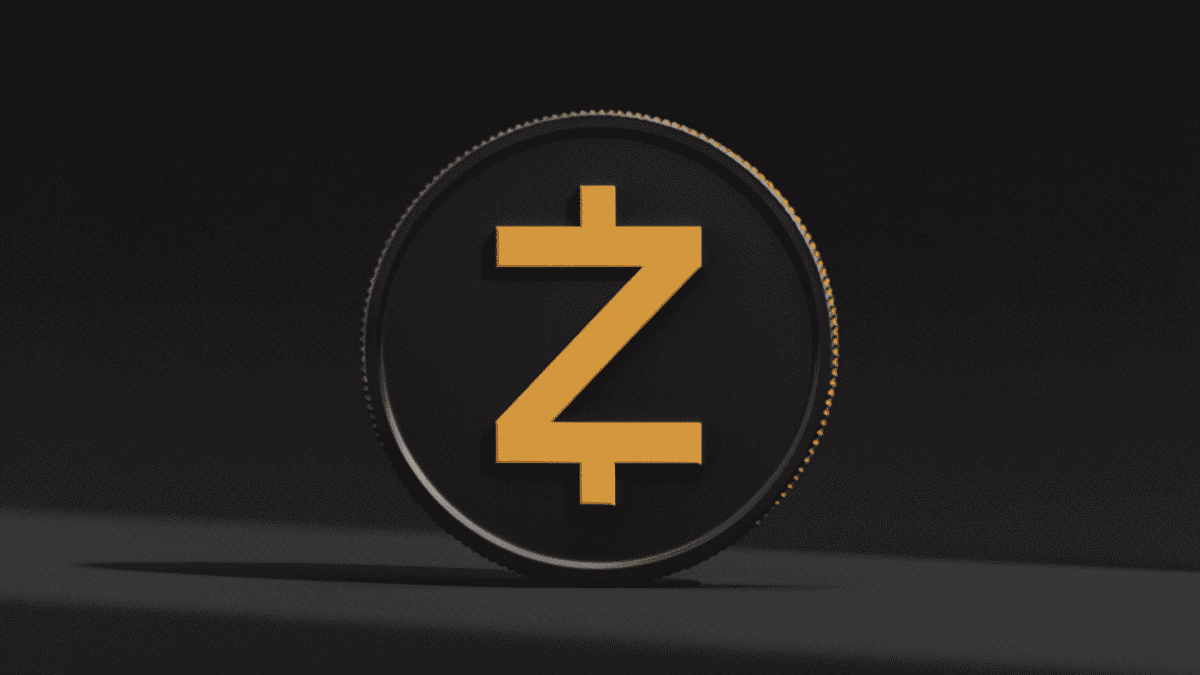
Zcash (ZEC) is a privacy coin and blockchain launched in 2016. It allows users to make both public and private transactions. The latter — called “shielded transactions” on the network — make use of zero-knowledge proofs called zk-SNARKs to verify payments without revealing the sender, recipient or amount.
Zcash has emerged as one of the largest cryptocurrencies by market capitalization following a sharp rally in 2026, as growing institutional interest and renewed demand for financial privacy have brought the decade-old project back into the spotlight.
Key Takeaways
- Zcash is a privacy-focused cryptocurrency built from Bitcoin's original codebase, with a maximum supply of 21 million ZEC.
- Zcash supports transparent transactions, which are publicly visible, and shielded transactions, which conceal sensitive financial information.
- Shielded transactions use zk-SNARKs, a type of zero-knowledge proof that allows transactions to be validated without exposing their underlying details.
- Viewing keys allow users to selectively disclose shielded transaction information without giving up control of their funds.
What is Zcash?
Zcash is a decentralized cryptocurrency designed to enable private digital payments. The Zcash network was originally derived from Bitcoin’s code base, beginning as an academic experiment in improving that network’s privacy protections. The network therefore retains some similarities to Bitcoin, including its use of proof-of-work mining to secure the network and fixed supply of 21 million coins.
The researchers behind Zcash originally conceived of a privacy extension for Bitcoin called Zerocoin. This idea developed into a separate protocol, Zerocash, which in turn provided the foundation for Zcash.
The main difference between Zcash and Bitcoin is their approaches to privacy. All activity on the Bitcoin network is public by design; anyone can view the balances of every address, along with their full transaction history, even though the identities of the holders are unknown.
Zcash, on the other hand, gives users the option to process their transactions privately. It offers transparent transactions, which function like a normal BTC transaction, as well as shielded transactions, which allow users to keep transaction details private through advanced cryptography.
The network launched in October 2016, and the nonprofit Zcash Foundation was established the following year to support the network and its development. Zcash has since evolved into a decentralized ecosystem spanning multiple independent organizations and contributors. The Zcash Foundation continues to maintain core infrastructure and support protocol development.
How do shielded transactions work?
Zcash’s shielded transactions make use of cryptographic proofs to verify transactions are legitimate while keeping the underlying information concealed. This means that the transaction amount, sender’s address and recipient’s address are all kept private.
To understand how this works, it helps to look at how Zcash handles private funds. Transactions on the network are processed in two parallel but separate accounting environments: the transparent ledger and shielded pools. The latter is where private transactions take place; shielded pools are parts of the chain where funds can be held and transferred without their ownership, balance and history being publicly visible.
According to figures displayed on the official Zcash network dashboard, approximately 29% of the issued ZEC supply was held in shielded pools as of October 2026. It is also worth noting that transactions moving between transparent and shielded pools can reveal the amounts entering or leaving those pools, which in turn could be used to infer relationships between addresses.
While the regular blockchain uses conventional public addresses, shielded pools instead represent funds as cryptographic records called notes. When a user processes a shielded payment, their wallet uses existing notes to create new ones for the recipient. This transaction is recorded on the Zcash blockchain, but observers cannot see who received the notes, which notes were spent or how much ZEC changed hands.
The network stores public commitments to these notes, allowing it to keep track of balances without all of the transaction details displayed on a public ledger. Verifying that private transactions follow the rules of the blockchain was one of the original challenges of privacy coins, one which Zcash solves through a cryptographic mechanism called zero-knowledge proofs.
What is a zero-knowledge proof?
A zero-knowledge proof (ZKP) is a cryptographic method that allows someone to prove a statement is true without revealing the underlying information used to establish it. Imagine if someone wanted to prove they were over 18 without revealing their exact date of birth — ZKPs are able to achieve a similar effect by using cryptographic mathematics.
Instead of broadcasting all of the information needed to verify a payment, the sender generates a cryptographic proof of its validity. Other users can view and verify that proof — the product of the cryptographic algorithm — while the information used to generate it is kept concealed.
Zcash uses a specific type of proof called a zero-knowledge succinct non-interactive argument of knowledge, or zk-SNARK. It also makes use of cryptographic identifiers called nullifiers attached to notes to prevent double-spending.
What are viewing keys?
Viewing keys introduce another level of control for Zcash users. These allow them to selectively reveal transaction data with third parties while keeping it hidden from the general public. These viewing keys give limited read-only access to the wallet without giving the holder the capability to spend the balance inside.
The network allows for different levels of visibility. For example, an incoming viewing key reveals only received payments, while a full viewing key reveals broader details of an account’s shielded activity.
This allows Zcash users to straddle the line between privacy and compliance. For example, an individual may need to reveal transaction records to their local tax authority during an audit, or a company may need to reveal its Zcash holdings to shareholders.
This is known as selective disclosure, allowing users to choose when and with whom they share financial information. Custom controls like this distinguish Zcash from networks like Monero (XMR), where all activity is anonymous by default.
What is the difference between transparent and shielded addresses?
Zcash supports transparent addresses that operate similarly to Bitcoin addresses and shielded addresses designed to protect transaction details. Unified addresses simplify the process by allowing users to manage both types of transaction from inside one wallet.
|
Address type |
Format |
Privacy |
|
Transparent (t-address) |
Begins with t1 or t3 |
Sender, recipient and transaction amounts are publicly visible |
|
Shielded address |
zs1 for Sapling; newer shielded receivers are incorporated into unified addresses |
Conceals transaction details when used in fully shielded transfers |
|
Unified address |
Begins with u1 |
Can support multiple receiving methods; privacy depends on which receiver is used |
How has Zcash's privacy technology evolved?
Zcash's privacy technology has undergone several major upgrades since the network launched in 2016. One of the biggest challenges facing its early developers was the need for a trusted setup, a process used to generate the cryptographic parameters required for its zero-knowledge proofs to function. This required multiple participants and left the network theoretically vulnerable to counterfeit shielded balances.
This convoluted process was streamlined by successive network upgrades:
- Orchard, 2022: Introduced an upgraded shielded pool and its Halo 2 proving system. Unlike earlier versions, Halo 2 did not require a trusted setup. The upgrade also introduced unified addresses, making it easier for compatible wallets to handle different types of transactions.
- Ironwood, 2026: Developers discovered and patched a vulnerability in Orchard’s zero-knowledge proofs that could have been exploited by an attacker to mint ZEC — Ironwood was later introduced with enhanced safeguards to protect ZEC’s supply.
The upgrade also restricted activity in the original Orchard pool and introduced a mechanism known as a turnstile, allowing existing funds to migrate to Ironwood while enforcing supply-integrity checks. Compatible wallets can handle this migration without requiring users to create a new wallet.
How is ZEC mined and what is its supply?
New ZEC coins enter circulation through proof-of-work mining. This is the same system used by Bitcoin, wherein miners dedicate computing power to solving complex mathematical problems, with the successful miners gaining the right to produce new blocks that are in turn validated by other nodes. The specific algorithm used by Zcash is called Equihash.
ZEC also shares a similar emission schedule with BTC, with a fixed supply cap of 21 million coins and a halving in new emissions roughly every four years. The most recent Zcash halving occurred in November 2024, cutting the block subsidy (the network reward paid to miners) to 1.5625 ZEC.
Unlike Bitcoin, however, Zcash also directs a portion of newly minted coins toward network development. A new funding model was introduced in November 2025 which now sees 80% of block subsidies paid to miners, 8% to community grants and 12% to a development fund controlled by ZEC holders.
Zcash vs Monero: What Is the difference?
Zcash and Monero are both privacy-focused cryptocurrencies, but they take different approaches to transaction confidentiality. The key difference is that Zcash allows users to opt in or out of private transactions, whereas all transactions on Monero are private by default. Both networks support viewing keys to reveal transaction information to selected individuals.
|
Feature |
Zcash (ZEC) |
Monero (XMR) |
|
Privacy model |
Optional shielded transactions |
Private by default |
|
Core technology |
zk-SNARKs, Halo 2 |
Ring signatures, stealth addresses, RingCT |
|
Maximum supply |
21 million ZEC |
No fixed cap; tail emission |
|
Mining algorithm |
Equihash |
RandomX |
|
Selective disclosure |
Viewing keys |
View keys and transaction proofs |
|
Transparent transactions |
Supported |
Not supported as a standard transaction mode |
It’s important to note that neither ZEC nor XMR guarantee complete anonymity. Zcash balances can be tracked while moving in or out of private pools, while wallets on both networks can potentially be de-anonymized if they interact with a user’s centralized exchange accounts.
Which blockchain provides better privacy solutions depends on the circumstances. Generally speaking, Monero's default privacy removes the need for users to manage custom privacy settings inside their wallet, while Zcash's optional approach offers greater flexibility for compliance.
Is Zcash legal? Privacy coins and regulation
The regulatory footing of privacy coins is complex and differs between jurisdictions. Generally, ZEC is legal to own and use; however, restrictions can apply to exchanges and other crypto platforms that handle ZEC even where individual ownership is permitted.
The European Union has taken one of the clearest regulatory stances against privacy coins, introducing legislation prohibiting crypto service providers from maintaining anonymous blockchain accounts.
In response to these pressures and ambiguities, some cryptocurrency exchanges have delisted privacy coins due to compliance concerns. Others restrict users from using shielded pools for deposits and withdrawals, requiring that these go through standard transparent transaction channels instead.
Although this does not establish a blanket ban on individuals owning Zcash, measures such as these can affect the accessibility of the privacy coin sector. Users should verify the rules applying to their jurisdiction and chosen service provider before trading or transferring ZEC.
What are the risks and limitations of Zcash?
Zcash offers solutions for blockchain users concerned about privacy, but it also carries certain risks that holders should be aware of. These are technical, regulatory and financial.
- Privacy limitations: Transfers into or out of shielded pools can reveal ZEC amounts that can potentially be used to de-anonymize shielded balances. Exchange records, network metadata and user behavior may also expose information.
- Security vulnerabilities: The Orchard vulnerability discovered in 2026 demonstrated how reliance on complex cryptography can leave security problems unaddressed for months or years.
- Exchange availability: Not all exchanges support shielded transfers, potentially requiring users to move funds through transparent addresses.
- Regulatory uncertainty: Restrictions on privacy coins may reduce access to trading platforms and other financial services.
- Market risk: Like other cryptocurrencies, ZEC is exposed to price volatility, liquidity constraints and changing market conditions.
Frequently Asked Questions
1. Is Zcash completely anonymous?
No. Shielded transactions can conceal the sender, recipient and amount, but Zcash does not guarantee complete anonymity. Transparent transactions remain publicly visible, while exchange records, network information and user behavior can reveal identifying details.
2. What is the difference between shielded and transparent Zcash transactions?
Transparent transactions publicly reveal wallet addresses and transaction amounts, much like Bitcoin. Shielded transactions use zero-knowledge proofs to conceal this information while allowing the network to verify the payment. Transfers between transparent and shielded pools can still reveal the amounts entering or leaving those pools.
3. Is Zcash similar to Tornado Cash?
No. Zcash is a privacy blockchain and coin, while Tornado Cash is a mixer protocol. Privacy coins are distinct from cryptocurrency mixers, which attempt to obscure the origins and destinations of funds moving across otherwise transparent blockchains. They do this by automating a complex web of transactions to obfuscate the trail of funds.
4. How is Zcash different from Bitcoin?
Zcash’s optional privacy features are its core differentiator from Bitcoin. Although ZEC was originally derived from Bitcoin’s code base, its developers added shielded transaction pools that use zero-knowledge proofs to enable private transfers.
5. Is Zcash better than Monero for privacy?
Neither cryptocurrency is universally better for privacy. Monero provides transaction confidentiality by default, while Zcash allows users to choose between shielded and transparent transactions. Both have different privacy trade-offs, and neither guarantees complete anonymity.
6. Is Zcash legal?
Zcash ownership and use are generally permitted in many jurisdictions, although restrictions vary by country. Some jurisdictions, such as the EU, have introduced legislation restricting cryptocurrency platforms from maintaining anonymous accounts. Although not a blanket ban, this could limit the accessibility of ZEC when it takes effect in July 2027.
7. How many ZEC will ever exist?
Zcash has a maximum supply of 21 million ZEC, matching BTC’s supply cap. New coins are issued through proof-of-work mining, with the block subsidy periodically reduced through halvings. The latest halving occurred in November 2024.
Related explainers

What are the different types of cryptocurrencies and tokens?
What is Tornado Cash?
Decentralized Compute