%20--%3e%3csvg%20version='1.1'%20id='Layer_1'%20xmlns='http://www.w3.org/2000/svg'%20xmlns:xlink='http://www.w3.org/1999/xlink'%20x='0px'%20y='0px'%20viewBox='0%200%20548.6%2081.8'%20style='enable-background:new%200%200%20548.6%2081.8;'%20xml:space='preserve'%3e%3cstyle%20type='text/css'%3e%20.st0{fill:%23B3B2B2;}%20.st1{fill:%23333333;}%20.st2{fill:%23CB2A27;}%20.st3{fill:%239E2F2B;}%20.st4{fill:url(%23SVGID_1_);}%20.st5{fill-rule:evenodd;clip-rule:evenodd;fill:url(%23SVGID_00000081627807623978665650000007530117608280222350_);}%20.st6{fill-rule:evenodd;clip-rule:evenodd;fill:url(%23SVGID_00000124158375052983877420000016440253345571772322_);}%20.st7{fill-rule:evenodd;clip-rule:evenodd;fill:url(%23SVGID_00000162331698164625215240000016248320423653895854_);}%20.st8{fill-rule:evenodd;clip-rule:evenodd;fill:url(%23SVGID_00000176745200934897492200000012315166769339453352_);}%20%3c/style%3e%3cg%3e%3cg%3e%3cg%3e%3cpolygon%20class='st0'%20points='270.3,9.2%20268.5,9.2%20268.5,8.5%20272.9,8.5%20272.9,9.2%20271.1,9.2%20271.1,14%20270.3,14%20'/%3e%3cpolygon%20class='st0'%20points='273.5,8.5%20274.5,8.5%20276.3,13.1%20278.2,8.5%20279.1,8.5%20279.1,14%20278.5,14%20278.5,9.5%20278.5,9.5%20276.6,14%20276,14%20274.2,9.5%20274.2,9.5%20274.2,14%20273.5,14%20'/%3e%3c/g%3e%3c/g%3e%3cpath%20class='st0'%20d='M299.9,0h4.1v79.5h-4.1V0z'/%3e%3cg%3e%3cpath%20class='st1'%20d='M331.7,8.9h19.8c18.7,0,31.5,12.8,31.5,29.4v0.2c0,16.8-12.8,29.7-31.5,29.7h-19.8V8.9L331.7,8.9z%20M336.1,12.8V64h15.4c16.5,0,27-11.3,27-25.4v-0.2c0-14-10.4-25.7-27-25.7H336.1z'/%3e%3cpath%20class='st1'%20d='M390.3,8h5.1v5.7h-5.1V8z%20M390.9,24.9h4.2v43.2h-4.2V24.9z'/%3e%3cpath%20class='st1'%20d='M405.4,75.3l2.4-3.3c5.1,3.9,11.2,6,17.5,6c10,0,16.9-5.7,16.9-16.8v-6.3c-3.8,5.3-9.5,10-18.1,10%20c-10.4,0-20.8-8-20.8-20.4v-0.2c0-12.5,10.4-20.5,20.8-20.5c8.6,0,14.5,4.5,18.1,9.7v-8.6h4.2v36.5c0,6.3-2,11.2-5.4,14.6%20c-3.8,3.8-9.4,5.7-15.7,5.7C418.1,82,411.4,79.7,405.4,75.3z%20M442.5,44.5v-0.2c0-10-8.9-16.5-17.8-16.5c-9.1,0-16.8,6.3-16.8,16.3%20v0.1c0,9.8,7.8,16.5,16.8,16.5C433.6,61,442.5,54.3,442.5,44.5z'/%3e%3cpath%20class='st1'%20d='M455.5,8h5.1v5.7h-5.1V8z%20M455.9,24.9h4.2v43.2h-4.2V24.9z'/%3e%3cpath%20class='st1'%20d='M473.8,57V28.7h-6.3v-3.8h6.3V11h4.2v13.9h15.2v3.8H478v27.9c0,6.2,3.6,8.5,8.6,8.5c2.1,0,3.9-0.5,6.3-1.5%20v3.9c-2.3,1.1-4.4,1.5-7.1,1.5C479.2,69,473.8,65.4,473.8,57z'/%3e%3cpath%20class='st1'%20d='M496.7,55.5v-0.2c0-9.1,7.7-14,18.9-14c6,0,10.1,0.8,14.3,1.8v-1.8c0-8.8-5.3-13.3-14.2-13.3%20c-5.3,0-9.5,1.5-13.6,3.5l-1.5-3.6c4.7-2.3,9.4-3.8,15.4-3.8c5.9,0,10.6,1.7,13.6,4.7c2.9,2.9,4.4,6.8,4.4,12.2v27h-4.1v-7.2%20c-3,4.2-8.3,8.1-16.5,8.1C505.3,69.1,496.7,64.6,496.7,55.5z%20M530,51.9v-5c-3.6-0.9-8.5-2-14.6-2c-9.2,0-14.2,4.1-14.2,10.1v0.2%20c0,6.3,5.9,10,12.5,10C522.5,65.4,530,59.9,530,51.9z'/%3e%3cpath%20class='st1'%20d='M544.4,6.3h4.2v61.9h-4.2V6.3z'/%3e%3c/g%3e%3c/g%3e%3cpolygon%20points='20.5,8.6%2020.5,50.5%2048.1,50.5%2048.1,68.2%200,68.2%200,8.6%20'/%3e%3cpolygon%20points='76.7,8.6%2089,28.8%20101.3,8.6%20122.4,8.6%20122.4,68.2%20102,68.2%20102,40.4%2089.2,60%2088.4,60%2075.7,40.4%2075.7,68.2%2055.5,68.2%2055.5,8.6%20'/%3e%3cpath%20d='M163.5,33.1l-4.6,12.3h9.3L163.5,33.1z%20M153.6,8.2h20.1l25.1,60l-22.3,0l-3.1-7.9h-19.8l-3,7.9h-22L153.6,8.2z'/%3e%3cpolygon%20points='242.6,8.6%20235.1,19.8%20246.8,37.1%20266.1,8.6%20'/%3e%3cpolygon%20points='266.6,68.1%20246.7,38.7%20235.1,55.9%20243.4,68.1%20'/%3e%3cg%3e%3cpolygon%20class='st2'%20points='201.6,67.7%20221.9,37.8%20202.5,9.1%20224.7,9.1%20244.2,37.8%20223.9,67.7%20'/%3e%3cpath%20class='st3'%20d='M224.5,9.6l19.1,28.2l-19.9,29.4h-21l19.5-28.8l0.4-0.6l-0.4-0.6L203.4,9.6L224.5,9.6%20M225,8.6h-23.5%20l19.7,29.2l-20.6,30.4h23.5l20.6-30.4L225,8.6L225,8.6z'/%3e%3c/g%3e%3cg%3e%3clinearGradient%20id='SVGID_1_'%20gradientUnits='userSpaceOnUse'%20x1='220.9093'%20y1='-950.0897'%20x2='220.9093'%20y2='-925.641'%20gradientTransform='matrix(1%200%200%20-1%200%20-916)'%3e%3cstop%20offset='0'%20style='stop-color:%23FFFFFF'/%3e%3cstop%20offset='0.9448'%20style='stop-color:%23D83A16'/%3e%3c/linearGradient%3e%3cpath%20class='st4'%20d='M203.5,9.6h21l13.9,20.5c0,0-5.1,2.5-18.3,4L203.5,9.6z'/%3e%3c/g%3e%3clinearGradient%20id='SVGID_00000102544490061922048680000006716673136051575428_'%20gradientUnits='userSpaceOnUse'%20x1='-829.9603'%20y1='-469.8219'%20x2='-829.2181'%20y2='-469.8219'%20gradientTransform='matrix(0%2056.2842%20-56.2842%200%20-26433.2578%2046715.5)'%3e%3cstop%20offset='0'%20style='stop-color:%23000000'/%3e%3cstop%20offset='8.490400e-02'%20style='stop-color:%231E1E1D'/%3e%3cstop%20offset='0.2228'%20style='stop-color:%23444443'/%3e%3cstop%20offset='0.3965'%20style='stop-color:%236C6B6B'/%3e%3cstop%20offset='0.5991'%20style='stop-color:%239D9C9C'/%3e%3cstop%20offset='0.8233'%20style='stop-color:%23D4D4D3'/%3e%3cstop%20offset='1'%20style='stop-color:%23FFFFFF'/%3e%3c/linearGradient%3e%3cpath%20style='fill-rule:evenodd;clip-rule:evenodd;fill:url(%23SVGID_00000102544490061922048680000006716673136051575428_);'%20d='%20M1,43.5C6.8,41.1,13.7,39,19.6,38V9.6H1V43.5z'/%3e%3clinearGradient%20id='SVGID_00000103957968551173334310000005412737639992854954_'%20gradientUnits='userSpaceOnUse'%20x1='-824.1308'%20y1='-473.5818'%20x2='-823.3696'%20y2='-473.5818'%20gradientTransform='matrix(0%2040.0685%20-40.0685%200%20-18886.7422%2033025.9883)'%3e%3cstop%20offset='0'%20style='stop-color:%23000000'/%3e%3cstop%20offset='8.490400e-02'%20style='stop-color:%231E1E1D'/%3e%3cstop%20offset='0.2228'%20style='stop-color:%23444443'/%3e%3cstop%20offset='0.3965'%20style='stop-color:%236C6B6B'/%3e%3cstop%20offset='0.5991'%20style='stop-color:%239D9C9C'/%3e%3cstop%20offset='0.8233'%20style='stop-color:%23D4D4D3'/%3e%3cstop%20offset='1'%20style='stop-color:%23FFFFFF'/%3e%3c/linearGradient%3e%3cpath%20style='fill-rule:evenodd;clip-rule:evenodd;fill:url(%23SVGID_00000103957968551173334310000005412737639992854954_);'%20d='%20M89,30.6l-12.8-21H56.5v25.1c24.2-3,48.1-1.9,64.9,0.1V9.6H102L89,30.6z'/%3e%3clinearGradient%20id='SVGID_00000045609548158379760350000004638969150694955421_'%20gradientUnits='userSpaceOnUse'%20x1='-828.1707'%20y1='-470.2902'%20x2='-827.4019'%20y2='-470.2902'%20gradientTransform='matrix(0%2050.0393%20-50.0393%200%20-23369.248%2041443.8047)'%3e%3cstop%20offset='0'%20style='stop-color:%23000000'/%3e%3cstop%20offset='8.490400e-02'%20style='stop-color:%231E1E1D'/%3e%3cstop%20offset='0.2228'%20style='stop-color:%23444443'/%3e%3cstop%20offset='0.3965'%20style='stop-color:%236C6B6B'/%3e%3cstop%20offset='0.5991'%20style='stop-color:%239D9C9C'/%3e%3cstop%20offset='0.8233'%20style='stop-color:%23D4D4D3'/%3e%3cstop%20offset='1'%20style='stop-color:%23FFFFFF'/%3e%3c/linearGradient%3e%3cpath%20style='fill-rule:evenodd;clip-rule:evenodd;fill:url(%23SVGID_00000045609548158379760350000004638969150694955421_);'%20d='%20M154.3,9.2l-11.9,28.4c5.1,0.9,10.5,1.1,17.7,1.8l3.4-9.1l3.5,9.2c6.3,0.2,11.4-0.5,18.1-1.5L173,9.2L154.3,9.2L154.3,9.2L154.3,9.2%20z'/%3e%3clinearGradient%20id='SVGID_00000098218655395796564910000006749387513598408615_'%20gradientUnits='userSpaceOnUse'%20x1='-817.4011'%20y1='-476.8813'%20x2='-816.6498'%20y2='-476.8813'%20gradientTransform='matrix(0%2030.094%20-30.094%200%20-14101.042%2024605.1211)'%3e%3cstop%20offset='0'%20style='stop-color:%23000000'/%3e%3cstop%20offset='8.490400e-02'%20style='stop-color:%231E1E1D'/%3e%3cstop%20offset='0.2228'%20style='stop-color:%23444443'/%3e%3cstop%20offset='0.3965'%20style='stop-color:%236C6B6B'/%3e%3cstop%20offset='0.5991'%20style='stop-color:%239D9C9C'/%3e%3cstop%20offset='0.8233'%20style='stop-color:%23D4D4D3'/%3e%3cstop%20offset='1'%20style='stop-color:%23FFFFFF'/%3e%3c/linearGradient%3e%3cpath%20style='fill-rule:evenodd;clip-rule:evenodd;fill:url(%23SVGID_00000098218655395796564910000006749387513598408615_);'%20d='%20M243.1,9.6l-6.9,10.2l5.7,8.5c5.8-1.8,9.2-3.2,13.7-6l8.5-12.6H243.1L243.1,9.6z'/%3e%3c/svg%3e)
%20--%3e%3csvg%20version='1.1'%20id='Layer_1'%20xmlns='http://www.w3.org/2000/svg'%20xmlns:xlink='http://www.w3.org/1999/xlink'%20x='0px'%20y='0px'%20viewBox='0%200%20548.6%2081.8'%20style='enable-background:new%200%200%20548.6%2081.8;'%20xml:space='preserve'%3e%3cstyle%20type='text/css'%3e%20.st0{fill:%23B3B2B2;}%20.st1{fill:%23FFFFFF;}%20.st2{fill:%23EDEDED;}%20.st3{fill:%23B2B2B2;}%20.st4{fill:%23CB2A27;}%20.st5{fill:%239E2F2B;}%20.st6{fill:url(%23SVGID_1_);}%20%3c/style%3e%3cg%3e%3cg%3e%3cg%3e%3cpolygon%20class='st0'%20points='270.3,9.2%20268.5,9.2%20268.5,8.5%20272.9,8.5%20272.9,9.2%20271.1,9.2%20271.1,14%20270.3,14%20'/%3e%3cpolygon%20class='st0'%20points='273.5,8.5%20274.5,8.5%20276.3,13.1%20278.2,8.5%20279.1,8.5%20279.1,14%20278.5,14%20278.5,9.5%20278.5,9.5%20276.6,14%20276,14%20274.2,9.5%20274.2,9.5%20274.2,14%20273.5,14%20'/%3e%3c/g%3e%3c/g%3e%3cpath%20class='st0'%20d='M299.9,0h4.1v79.5h-4.1V0z'/%3e%3cg%3e%3cpath%20class='st1'%20d='M331.7,8.9h19.8c18.7,0,31.5,12.8,31.5,29.4v0.2c0,16.8-12.8,29.7-31.5,29.7h-19.8V8.9L331.7,8.9z%20M336.1,12.8V64h15.4c16.5,0,27-11.3,27-25.4v-0.2c0-14-10.4-25.7-27-25.7H336.1z'/%3e%3cpath%20class='st1'%20d='M390.3,8h5.1v5.7h-5.1V8z%20M390.9,24.9h4.2v43.2h-4.2V24.9z'/%3e%3cpath%20class='st1'%20d='M405.4,75.3l2.4-3.3c5.1,3.9,11.2,6,17.5,6c10,0,16.9-5.7,16.9-16.8v-6.3c-3.8,5.3-9.5,10-18.1,10%20c-10.4,0-20.8-8-20.8-20.4v-0.2c0-12.5,10.4-20.5,20.8-20.5c8.6,0,14.5,4.5,18.1,9.7v-8.6h4.2v36.5c0,6.3-2,11.2-5.4,14.6%20c-3.8,3.8-9.4,5.7-15.7,5.7C418.1,82,411.4,79.7,405.4,75.3z%20M442.5,44.5v-0.2c0-10-8.9-16.5-17.8-16.5c-9.1,0-16.8,6.3-16.8,16.3%20v0.1c0,9.8,7.8,16.5,16.8,16.5C433.6,61,442.5,54.3,442.5,44.5z'/%3e%3cpath%20class='st1'%20d='M455.5,8h5.1v5.7h-5.1V8z%20M455.9,24.9h4.2v43.2h-4.2V24.9z'/%3e%3cpath%20class='st1'%20d='M473.8,57V28.7h-6.3v-3.8h6.3V11h4.2v13.9h15.2v3.8H478v27.9c0,6.2,3.6,8.5,8.6,8.5c2.1,0,3.9-0.5,6.3-1.5%20v3.9c-2.3,1.1-4.4,1.5-7.1,1.5C479.2,69,473.8,65.4,473.8,57z'/%3e%3cpath%20class='st1'%20d='M496.7,55.5v-0.2c0-9.1,7.7-14,18.9-14c6,0,10.1,0.8,14.3,1.8v-1.8c0-8.8-5.3-13.3-14.2-13.3%20c-5.3,0-9.5,1.5-13.6,3.5l-1.5-3.6c4.7-2.3,9.4-3.8,15.4-3.8c5.9,0,10.6,1.7,13.6,4.7c2.9,2.9,4.4,6.8,4.4,12.2v27h-4.1v-7.2%20c-3,4.2-8.3,8.1-16.5,8.1C505.3,69.1,496.7,64.6,496.7,55.5z%20M530,51.9v-5c-3.6-0.9-8.5-2-14.6-2c-9.2,0-14.2,4.1-14.2,10.1v0.2%20c0,6.3,5.9,10,12.5,10C522.5,65.4,530,59.9,530,51.9z'/%3e%3cpath%20class='st1'%20d='M544.4,6.3h4.2v61.9h-4.2V6.3z'/%3e%3c/g%3e%3cg%3e%3cg%3e%3cpolygon%20class='st2'%20points='0.5,67.9%200.5,9.1%2020.1,9.1%2020.1,51%2047.8,51%2047.8,67.9%20'/%3e%3cpath%20class='st3'%20d='M19.6,9.5v41.1v0.9h0.9h26.7v15.8H0.9V9.5H19.6%20M20.7,8.5H0v59.9h48.3V50.6H20.7V8.5L20.7,8.5z'/%3e%3c/g%3e%3cg%3e%3cpolygon%20class='st2'%20points='102.8,67.9%20102.8,38.8%2089.3,59.6%2088.9,59.6%2075.5,38.8%2075.5,67.9%2056.1,67.9%2056.1,9.1%2076.7,9.1%2089.3,29.6%20101.9,9.1%20122.4,9.1%20122.4,67.9%20'/%3e%3cpath%20class='st3'%20d='M121.9,9.5v58h-18.7v-27v-3.2l-1.8,2.7L89.2,59L76.8,39.8L75,37.1v3.2v27H56.6V9.5h19.8l12.1,19.8l0.8,1.4%20l0.8-1.4L102,9.5L121.9,9.5%20M122.9,8.5h-21.3L89.3,28.7L77,8.5H55.7v59.9h20.2V40.4l12.7,19.8h0.9l12.7-19.8v27.9h20.5V8.5H122.9%20z'/%3e%3c/g%3e%3cg%3e%3cpath%20class='st2'%20d='M177.5,67.9l-3.2-7.8h-20.5l-3,7.8h-21l24.8-59.3H174l24.8,59.3H177.5z%20M158.8,46h10.7l-5.3-14.2L158.8,46z'%20/%3e%3cpath%20class='st3'%20d='M173.7,9.1L198,67.5h-20.2l-2.9-7.2l-0.3-0.6H174h-19.9h-0.6l-0.3,0.6l-2.7,7.2h-20.1l24.4-58.4H173.7%20M158,46.5h1.4h9.4h1.4l-0.5-1.4L165,32.8l-0.9-2.4l-0.9,2.4l-4.7,12.4L158,46.5%20M174.3,8.1h-20.2l-25.2,60.2h22.2l3-7.8H174%20l3.2,7.8h22.3L174.3,8.1L174.3,8.1z%20M159.5,45.6l4.7-12.4l4.7,12.4H159.5L159.5,45.6z'/%3e%3c/g%3e%3cg%3e%3cpolygon%20class='st2'%20points='236.5,19.8%20243.7,9.1%20266.2,9.1%20247.7,36.2%20'/%3e%3cpath%20class='st3'%20d='M265.3,9.5l-17.7,26l-10.6-15.7L244,9.5L265.3,9.5%20M267.1,8.5h-23.5L236,19.6L247.8,37L267.1,8.5L267.1,8.5z%20'/%3e%3c/g%3e%3cg%3e%3cpolygon%20class='st2'%20points='244.6,67.8%20236.7,56%20247.7,39.5%20266.8,67.8%20'/%3e%3cpath%20class='st3'%20d='M247.7,40.4l18.3,26.9h-21L237.3,56L247.7,40.4%20M247.7,38.8L236,56l8.3,12.4h23.2L247.7,38.8L247.7,38.8z'/%3e%3c/g%3e%3cg%3e%3cpolygon%20class='st4'%20points='202.4,67.9%20222.8,37.9%20203.3,9.1%20225.6,9.1%20245.1,37.9%20224.7,67.9%20'/%3e%3cpath%20class='st5'%20d='M225.3,9.5l19.2,28.2l-20.1,29.6h-21.1l19.6-29l0.5-0.6l-0.5-0.6L204.2,9.4h21.1%20M225.9,8.5h-23.5l19.9,29.3%20l-20.7,30.5H225l20.7-30.5L225.9,8.5L225.9,8.5z'/%3e%3c/g%3e%3cg%3e%3clinearGradient%20id='SVGID_1_'%20gradientUnits='userSpaceOnUse'%20x1='166.4754'%20y1='-918.2897'%20x2='166.4754'%20y2='-934.5494'%20gradientTransform='matrix(1.5092%200%200%201.5092%20-29.5361%201419.9884)'%3e%3cstop%20offset='0'%20style='stop-color:%23FFFFFF'/%3e%3cstop%20offset='0.9448'%20style='stop-color:%23D83A16'/%3e%3c/linearGradient%3e%3cpath%20class='st6'%20d='M204.2,9.5h21.1L239.2,30c0,0-5.1,2.4-18.4,3.9L204.2,9.5z'/%3e%3c/g%3e%3cpath%20class='st1'%20d='M0.9,43.6c5.9-2.4,12.7-4.5,18.7-5.6V9.5H0.9V43.6z'/%3e%3cpath%20class='st1'%20d='M89.3,30.6L76.5,9.5H56.7v25.2c24.3-3,48.3-2,65.2,0.2V9.5h-19.6L89.3,30.6z'/%3e%3cpath%20class='st1'%20d='M154.8,9.1l-11.9,28.5c5.1,0.9,10.6,1.1,17.8,1.8l3.5-9.2l3.5,9.2c6.3,0.2,11.5-0.5,18.3-1.5L173.7,9.1H154.8%20z'/%3e%3cpath%20class='st1'%20d='M244,9.5l-6.9,10.3l5.7,8.5c5.9-1.8,9.2-3.2,13.7-6l8.6-12.7H244z'/%3e%3c/g%3e%3c/g%3e%3c/svg%3e)


Crypto Makes Owning a Picasso a Click Away

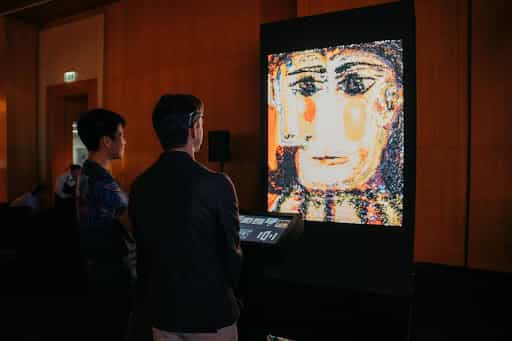
What do you imagine buying physical art to be like? Auction houses? Bidding? Expensive transportation? One way or another, it probably seems like an exorbitant and tedious process. In fact, it used to be like that up until April 15 when Alina Krot, CEO of 10101.art, announced the official launch of the project, marking the beginning of the art ownership revolution.
10101.art, a revolutionary art tokenization platform, went live on April 15 in Dubai. The event was hosted at their partner gallery, Monada Art, located inside the Ritz-Carlton, DIFC. The private gathering brought together the elite of the modern art market.
10101.art—The Leaders of Art Revolution
10101.art heralds a new era of art ownership. The platform utilizes art tokenization, a process that leverages blockchain technology, to split ownership of renowned artworks by legendary artists like Picasso, Dali, and Warhol. This innovative approach allows individuals to become co-owners of these masterpieces, making the art market more inclusive.
10101.art’s collection includes paintings by Picasso, Dali, Banksy, Warhol, and Gus Van Sant, with many more incoming. Let’s now explore the artworks offered by the platform and their creators.
Pablo Picasso
A towering figure in 20th-century art, Pablo Picasso stands out for his revolutionary approach. His most recognized achievement is Cubism, a legendary style he co-founded. Inspired by African and Iberian art, he also contributed to the rise of Surrealism and Expressionism. Throughout his career, Picasso produced over 20,000 paintings, prints, sculptures, ceramics, and even theater set designs. Today, he remains one of the best-selling artists of all time, with some paintings fetching hundreds of millions of dollars. Picasso’s most expensive painting is a work titled “Les Femmes d’Alger,” which sold for $179.3 million at a Christie’s auction in 2015.
Tête de Femme No. 5 (Portrait of Dora Maar)
This masterpiece was painted during the Spanish Civil War. Dora Maar was a photographer and one of Picasso’s lovers. Through his signature style, Picasso deconstructs and reimagines Maar’s form, capturing the layers of emotion and history within the canvas. The cost of a work from the series is currently estimated at €25 million. Estimates suggest that Picasso created over 60 drawings and paintings featuring Dora Maar.
Picasso’s “Dora Maar” portraits are valuable because of their connection to both art history and Picasso himself. Their worth stems from Picasso’s artistic fame, his innovative Cubist style in many of them, the emotional depth reflecting his tumultuous relationship with Dora Maar during the Spanish Civil War, and the historical significance of that era.
Nature Morte au Verre sous la Lampe
Created in 1962, this work showcases a lesser-known side of Picasso. While he is famous for Cubism and fracturing forms, “Nature Morte” embraces a more traditional still-life format, Nonetheless, Picasso being Picasso, he incorporated his unique style into it; “Nature Morte” is a linocut print. This technique involves carving a design onto a linoleum block, inking it, and then pressing it onto paper. There are only 50 known prints of “Nature Morte au Verre sous la Lampe.” While auction results are scarce, one signed print sold for an estimated range of $480,000–$720,000 in 2017.
Salvador Dalí
Born in 1904 in Figueres, Spain, Dalí carved out a niche for himself in the art world with his unparalleled ability to depict the bizarre and fantastic with remarkable precision and clarity. Dalí wasn’t a one-hit wonder. He was a true Renaissance man, excelling as a sculptor, filmmaker, writer, and even a stage designer. His artistic curiosity truly knew no bounds.
Dalí is consistently one of the best-selling artists at auctions. His work is highly sought after by collectors. The current record for the highest price paid for a Dalí artwork at an auction belongs to “Portrait de Paul Éluard” (1929), which fetched a staggering $21.74 million at Sotheby’s London in 2011.
Sans Titre (Homme-Arbre au Coeur Écorché)
The painting’s title, which translates to “Untitled (Man
-Tree with a Flayed Heart),” sets the stage for a deeply unsettling yet undeniably captivating visual experience.
2
The man-tree figure represents the fusion of humanity with nature, suggesting that we are not separate from the natural world but rather an integral part of it. The exposed heart, flayed and vulnerable, is a powerful symbol of human suffering and the pain we carry within us.
Estimates suggest that there are approximately 10–15 “Sans titre (Homme-arbre au coeur écorché)” paintings by Dalí, and one of them is available on 10101.art.
Gus Van Sant
While filmmaking is his primary artistic language, Gus Van Sant’s paintings offer a more intimate and introspective exploration of emotions. He predominantly uses watercolors, known for their fluidity and emotional resonance, to create dreamlike and melancholic scenes.
Van Sant’s paintings share a beautiful dialogue with his films. Both mediums explore similar themes—alienation, loneliness, the search for meaning, etc. Understanding his paintings deepens our appreciation for the emotional complexities he portrays on screen.
“Mona Lisa #11”
Gus Van Sant’s “Mona Lisa #11” is a recent work that has garnered attention for its unique reinterpretation of Leonardo da Vinci’s iconic masterpiece. The interesting aspect of “Mona Lisa #11” lies in the materials Van Sant employs. He combines gold leaf, crayon, and oil paint to create a textured and visually striking image.
By reimagining the “Mona Lisa,” Van Sant opens a dialogue between the past and present, thus making this particular artwork so significant within the broader art historical context.
Andy Warhol
The king of Pop Art, Andy Warhol, blurred the lines between high art and popular culture, using everyday objects and celebrities as his subjects. A true multimedia artist, Warhol wasn’t confined to canvas. He embraced photography, filmmaking, and even music production, leaving his mark on popular culture.
Andy Warhol’s most expensive work “Shot Sage Blue Marilyn” sold for $195 million at Christie’s New York in May 2022. In fact, it became the most expensive 20th-century work of art ever sold at auction.
Campbell’s Soup/Scott Broth F & S II.49
Any art enthusiast is familiar with the “Campbell’s Soup Cans” collection. Warhol wasn’t just being playful in picking a can as a subject. These seemingly simple paintings were a punch in the gut to the art world. He questioned the idea of artistic elitism, asking why a soup can couldn’t be as worthy of appreciation as a Renaissance masterpiece. He forced viewers to confront the beauty hidden in everyday objects, the significance of the mundane.
The “Soup Cans” remain an iconic image. They are instantly recognizable and have been referenced countless times in advertising, music, and other art forms. Warhol’s work helped make Pop Art a major artistic movement of his time, popular to this day.
One of the paintings from the series, “Campbell’s Soup/Scott Broth F & S II.49” is a true gem of 10101.art. The “F & S II.49” in the title likely refers to the size of the canvas (most probably “Full Sheet”) and a numbering system Warhol used to identify his works. This specific numbering suggests that it was created relatively early in the series, profoundly increasing its value.
“Campbell’s Soup Cans” by Andy Warhol is already available for purchase on 10101.art. There are 1200 2 x 2 cm pieces in total, worth $250 each. The new sales phase starts soon!
Banksy
Banksy. The name itself is a mystery; it is a pseudonym that fuels the intrigue surrounding this anonymous street artist. Believed to be from Bristol, England, Banksy emerged in the 1990s scene with a distinct brand of stencil graffiti that blended social commentary with dark humor.
Beneath the mask of anonymity lies a powerful voice. Banksy’s art tackles themes of war, consumerism, and social inequality. He critiques the powerful, highlighting the hardships of the marginalized. His work is a call to action that urges us to question the status quo and fight for a more just world.
Banksy’s painting “Love is in the Bin” was sold at Sotheby’s auction for $25.4 million and became the most expensive work by the artist.
Turf War
Banksy created “Turf War” in 2003 for his first major exhibition of the same name. By taking a well-known image of a revered historical figure and adding to it a rebellious element like the mohawk, Banksy aimed to challenge our perception of authority figures.
The green mohawk wasn’t just a random choice. It was likely inspired by the May Day 2000 protests in London’s Parliament Square, where protestors defaced a statue of Churchill with a turf mohawk. “Turf War” perfectly embodies Banksy’s signature style. It is witty, thought-provoking, and makes a powerful social statement.
“Turf War” is also available for purchase on 10101.art. There are 1500 1 x 1 cm pieces in total, worth $100 each. A new presale is starting soon, so don’t miss out on an opportunity to get your own Banksy.
Choose Your Weapon (Gold) VIP
In this artwork, Banksy pays homage to Keith Haring, appropriating Haring’s famous dog icon to imply that there are alternatives to violence, hinting on the expression “The pen is mightier than the sword.”
This artwork is a screen print, a technique where ink is pressed through a stencil onto the surface. Unlike many “Choose Your Weapon” pieces that come in various colors, the “Gold” version adds a layer of exclusivity and luxury with its metallic sheen. The “VIP” extension
here distinguishes this piece from the standard “Choose Your Weapon” series. It was produced in a limited edition, specifically for a select group of collectors.
Art as a Real-World Asset
Real-world assets (RWAs) represent a major trend in the art market that is led by 10101.art. RWAs are valuable things that exist in the physical world and not just in the digital realm. They can be categorized into
- tangible assets, such as artworks, real estate and commodities, and
- intangible assets, such as intellectual property and financial instruments.
The key concept behind RWAs is that they are brought onto a blockchain through a process called tokenization that creates a digital token representing ownership of the real-world asset.
However, RWA tokenization often involves certain legal hurdles, such as regulation, authenticity checks (specifically in the art sector), legally bridging tokens with real-world assets, etc. 10101.art overcomes all legal challenges, thanks to its unique legal framework, and ensures the proof of co-ownership to every user.
It’s important to note that 10101.art is more than just a digital art platform. Every physical painting offered on 10101.art is stored in Monada Art Gallery in Dubai, Ritz-Carlton DIFC. The gallery’s doors are open for any art enthusiast who is eager to explore 10101.art’s collection and immerse themselves in the fascinating world of fine art.
Ready to join the world of art collecting? Explore 10101.art and find the perfect piece to call your own.
With 10101.art, you can easily
- enrich your portfolio with prosperous RWAs,
- get closer to art, and
- become a part of the community of art enthusiasts.
This post is commissioned by Blockman and does not serve as a testimonial or endorsement by The Block. The post is for informational purposes only and should not be relied upon as a basis for investment, tax, legal or other advice. You should conduct your own research and consult independent counsel and advisors on the matters discussed within this post. Past performance of any asset is not indicative of future results.

OKX's Lennix Lai: Retail Traders Are Already Executing Through AI Agents
More videos →